
All That Shimmers
mixed metals, and a book to make you think


The Fifth Pillar is emotional intelligence (EQ) with a pulse: think EQ in action, not theory. I outgrew my old title (Dear People Pleasers). Like shoes two sizes too small, it pinched. So I made room: The Fifth Pillar is where I can stretch, stumble, and grow in my approach to both writing and the pursuit of a deeply fulfilled life. If my essays or poems hit home or inspire you to try today’s writing style yourself, consider this your VIP invite. I’ll be hanging out (or hoping to be) in your inbox every Tuesday.
Howdy partners,
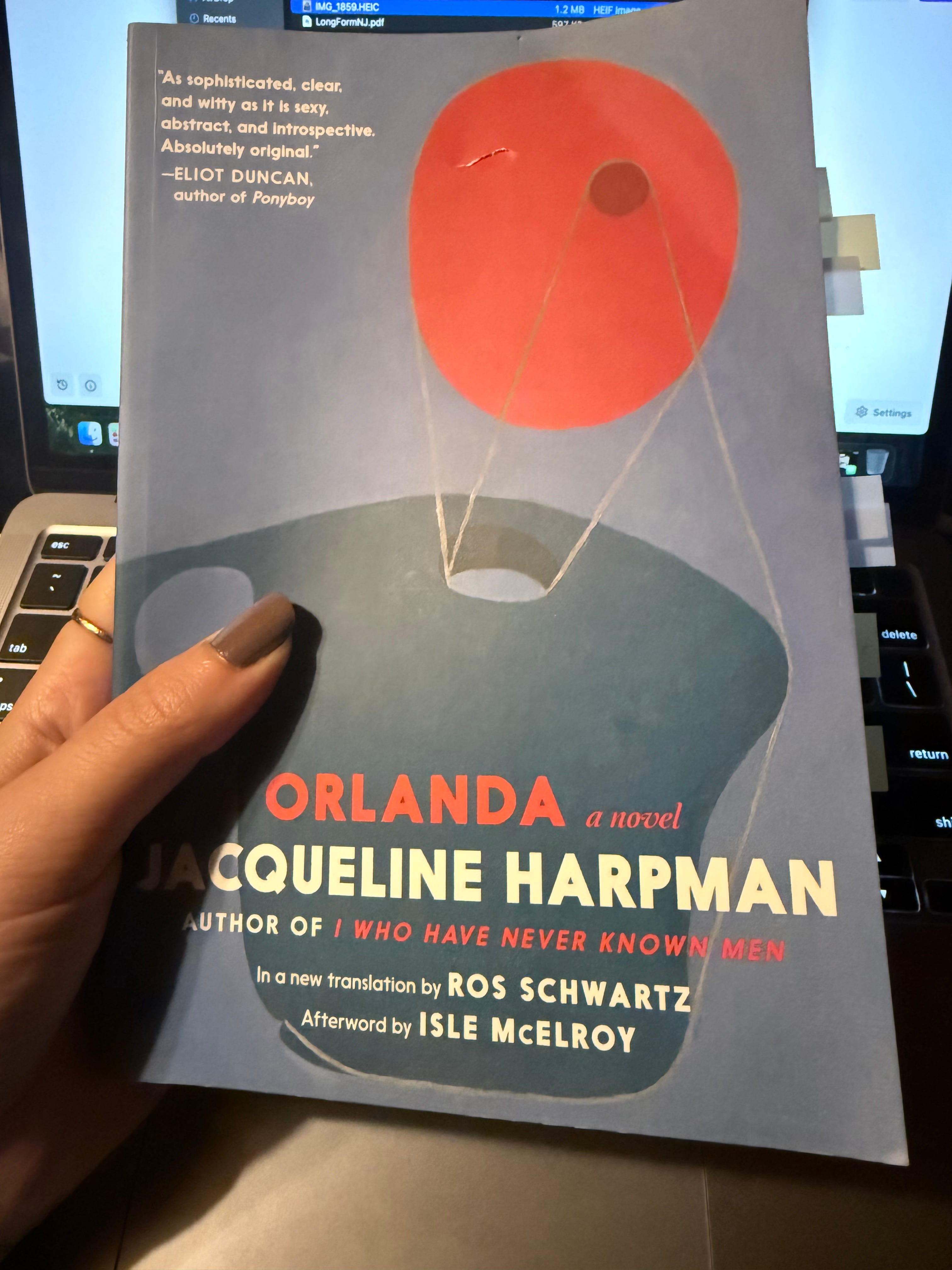
This week, I cleverly found a way to deliver you two thoughts in one: I recently finished a book I used a very aged gift card to buy, called Orlanda. I have also been thinking of and learning about metals. The nobel ones.
Don’t worry- there are no spoilers below, because I do hope to inspire someone to go out and read this book - I NEED someone older than five to discuss with. The author, Jacqueline Harpman, also wrote I Who Have Never Known Men, which I have on my list. I grabbed this book off the shelf, not because I have ever heard of it, but because someone at the bookstore left a sticky note, indicating that this is now a banned book due to its exploration of gender and identity. Incredible sales tactic. Never have I purchased a book so quickly.
Harpman (1929-2012) was a Belgian author and psychoanalyst - if you enjoy psychology, pondering the idea of masculine vs feminine, or self-exploration, AKA: emotional intelligence, this is an incredible, brilliant read. Ros Schwartz translated the work, and I have to hand it to her. 10/10 translation Ros- I wouldn’t want to read this book any other way.
The intel around the mixed metals was really just a bonus, and I’d also love to chat with anyone who cares for silver (or gold). I am curious which one appeals to you?
Thank you so much for being here and for indulging my latest musings.
May you be decorated in only the noblest of shimmering mixed metals,
xX kaylen alexandra Xx
Different though the sexes are, they intermix. In every human being a vacillation from one sex to the other takes place, and often it is only the clothes that keep the male or female likeness.
—Virginia Woolf
In my first read of 2026, Orlanda, Jacqueline Harpman imagines a woman split not by madness, but by possibility. Aline does not lose herself when her masculine counterpart appears in front of her wearing a stranger’s body; instead, she gains access to another register of being. Aline names her male persona, Orlanda, as a nod to Virginia Woolf’s story, Orlando. (I’ve never read Orlando and can confirm that you don’t need to for understanding or enjoying, Orlanda.)
Please note that Orlanda is not Aline’s opposite, but another side of her consciousness - proof that yin and yang are not rivals so much as two sides of the same coin.
I think of this often when I think about metals:
Gold radiates like the sun, like Orlanda.
Silver reflects the shimmer of stars, like Aline.
We have both, but the sun demands our attention.
Gold is impossible to ignore. It glows, warms, insists. Our lives bend around it: wake, work, produce, perform. The sun tells us when it’s time to move, when to be useful, when to be seen.
Gold radiates: directive, commanding, so proud.
Gold does not seek permission to exist.
Silver lives on the opposite side of that certainty.
Everyone would notice if they woke to a darkened sky.
Hidden by night, it does not command attention. It waits. It reveals itself only to those willing to slow down, to let their eyes adjust. Like starlight, its beauty is quiet and cumulative. You must linger to appreciate it.
Gold has long been associated with masculinity, being perceived as strong, resilient, and indestructible. A noble metal, it does not rust or tarnish. It survives time without showing wear. Even its softness is paradoxical: gold is the most malleable and ductile of all metals, capable of being stretched impossibly thin without breaking. Strength, it turns out, does not need to announce itself loudly, but gold still carries the mythology of dominance and visibility.
For most of my life, I reached for it instinctively.
Gold jewelry, real or convincingly artificial, became a kind of armor. When I wear it, I signal confidence outwardly, cultivating an exterior strength that sometimes masks my inner uncertainty. Gold helps me take up space. It lets me borrow certainty. It feels aspirational, protective, and loud enough to cover up any hesitation.
There is something fitting about this, considering gold’s origin. Scientists believe it was forged in supernovae, violent stellar explosions that scatter precious matter across the universe. Gold is born of force. Of spectacle. Of a collapse that still manages to shine.
Silver arrives differently.
Lately, I’ve found myself reaching for it, instead. Less thrilling. Less declarative. It carries a quieter confidence, one that does not need to prove itself. Silver does not perform. It reflects. It accepts. It trusts that being, is enough.
Silver feels feminine. Not in the ornamental sense, but in the ancient one. Cyclical. Intuitive. Receptive without being passive. It does not generate light; it responds to it. It teaches me that worth does not require brightness to be real.
This is where Orlanda returns.
Aline’s male self moves through the world with freedoms she is denied, not because he is braver, but because masculinity grants him permission. Harpman does not suggest that Orlanda is truer than Aline, only that he believed in himself more readily. The tragedy is not in the split, but the necessity of it.
Gold and silver live inside us this way.
We are taught to prize gold - to chase visibility, productivity, certainty. To value what shines longest and resists decay.
Silver reminds us that reflection is also a form of strength. That subtlety is not weakness. Some truths only surface in quiet, low light.
Masculine and feminine energies coexist in all of us, regardless of the bodies we inhabit. One asserts. One listens. One moves forward. One pulls inward. When we honor only gold, we burn ourselves out. When we dismiss silver, we lose depth.
Aline needed Orlanda to gain a masculine perspective.
But she also needed to appreciate her own feminine perspective.
When I choose what to wear, what to project, what to protect, I try to let both metals rest against my skin. I try to glow when it is time. To reflect when it is time. To trust that neither cancels the other out - they both matter - equally.
Somewhere between silver and gold, between Aline and Orlanda, between Heads or Tails, we are allowed to be whole.
📬 P.S. Want a Custom Card?
Paid subscriptions help me study the craft of storytelling. If you find value in my work, I will make sure you know exactly how you have supported me. I send decked-out physical snail-mail style cards to all paid subscribers as a tangible THANK YOU from the most grateful part of me, to you! When you upgrade- I will get your mailing address and send you a letter.
The way you weaved your reflections on the book in with your thoughts on the metals was nothing short of alchemy.
I had never thought about gold or silver in these ways. Admittedly, I don’t have or wear much of either. But I have always liked the idea of wearing an unassuming silver ring, I still haven’t done it yet, though. Maybe after this post… 🤔
Also, I really liked this line,
“Silver does not perform. It reflects. It accepts. It trusts that being, is enough.” :)
What an interesting reflection Kaylen. I've always worn silver and in my youth felt like it was because I wasn't classy or fashionable enough (later felt it was a skin tone choice). But interestingly, I have also always been drawn so much to the moon and all its feminine symbolism, so reading this essay gave me a very new way to think about it. I also find the spirituality behind alchemical process so intriguing. Thanks for sharing this!